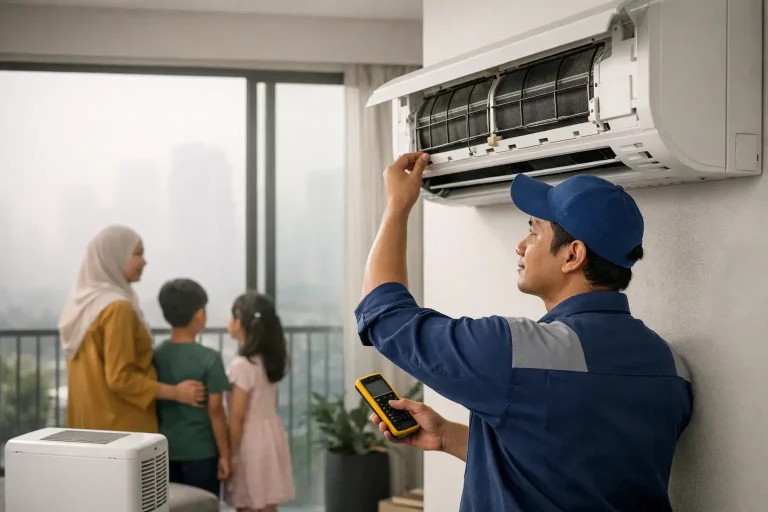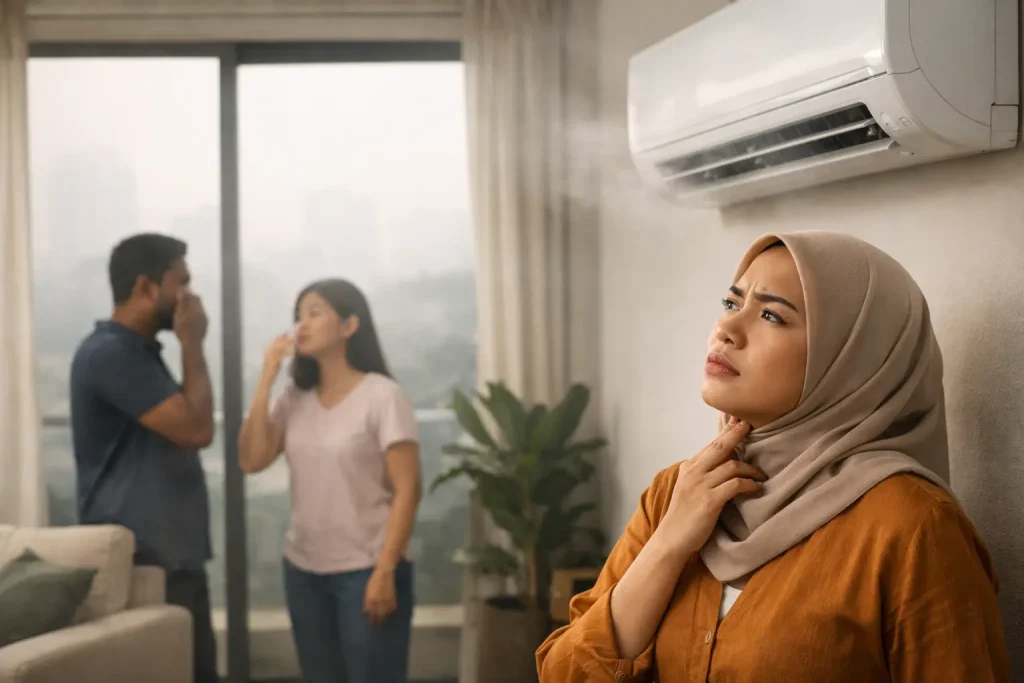
Malaysia is experiencing a serious haze episode. On 8 September 2026, 29 locations recorded unhealthy to hazardous Air Pollutant Index readings, according to reports based on Malaysia’s Air Pollutant Index Management System. Days earlier, pollution in parts of Sarawak reached emergency levels.
When the outdoor air looks grey and smells smoky, many of us close the windows, switch on the air conditioner and stay indoors. That is sensible for comfort—but it also means the air-conditioning system may run longer while airborne particles are finding their way onto filters, coils and outdoor equipment.
Haze will not normally destroy a healthy air conditioner overnight. However, heavy particle exposure combined with long operating hours and neglected maintenance can reduce airflow, make cooling less efficient, raise electricity consumption and contribute to premature wear.
The good news is that most of this strain is manageable with regular cleaning, sensible use and timely professional servicing.
What Is in Haze?
Haze is a suspension of fine airborne particles associated with smoke and other pollutants. Of particular concern is PM2.5—particles with an aerodynamic diameter of 2.5 micrometres or less. Malaysia’s Meteorological Department monitors PM2.5 as part of its atmospheric observations.
These particles are much smaller than ordinary household dust. They can remain airborne for long periods and enter buildings through open doors and windows, gaps, ventilation systems and normal movement in and out of the home.
Once indoors, some particles settle on furniture and floors. Others remain suspended and circulate through the room.
Does Your Air Conditioner Pull Haze into the House?
This is a common misunderstanding.
Most wall-mounted split air conditioners in Malaysian homes recirculate indoor air. They generally do not draw a continuous supply of outdoor air into the room. Closing windows and doors therefore helps reduce the amount of smoky outdoor air entering the home.
However, an ordinary split air conditioner is not automatically an air purifier. Its standard mesh filter is mainly designed to catch larger dust particles and protect the equipment. It may not remove the smallest haze particles effectively unless the unit has an appropriate fine-particle filtration system.
Haze that has already entered the room can still circulate through the indoor unit and settle on its filter and heat-exchanger coil. At the same time, the outdoor condenser is directly exposed to polluted ambient air.
How Haze Can Affect the Indoor Unit
1. The filter clogs faster
The indoor filter is the first line of defence against circulating dust and particles. During a severe haze period, it may become dirty faster than under normal conditions.
A clogged filter restricts airflow. The room may then take longer to cool, the fan may work harder and the system may run for longer periods to achieve the selected temperature.
Daikin explains that dust accumulation on a filter reduces airflow and can increase electricity use. Its general guidance recommends cleaning filters about once every two weeks during daily use, while noting that the interval depends on operating conditions. During heavy haze, homes in affected areas may need to inspect filters more frequently.
2. Dirt accumulates on the evaporator coil
Behind the filter is the indoor heat exchanger, often called the evaporator coil. Its thin metal fins transfer heat from the room air into the refrigerant.
When dust passes through or around an overloaded filter, it can coat these fins. That layer interferes with airflow and heat transfer, potentially causing weaker cooling and longer running time.
The fins are delicate and can bend easily. Internal coil cleaning should therefore be performed by a trained technician rather than attacked with a hard brush or strong household chemical.
3. The drain system may become dirtier
Air conditioners remove moisture from humid indoor air. This condensation flows through a drain pan and pipe.
Dust and organic matter can combine with moisture inside the unit, contributing to sludge or blockage. Warning signs include water dripping from the indoor unit, musty odours or unusual gurgling sounds.
Haze alone is not necessarily the sole cause of a blocked drain, but extra particle loading can add to an already dirty system.
How Haze Can Affect the Outdoor Unit
The condenser releases heat outside. It must move outdoor air across its coil to do this efficiently.
During haze, the outdoor unit is exposed to fine soot, dust, leaves and other debris. A dirty coil makes heat rejection more difficult. The compressor may have to operate longer, particularly during Malaysia’s hot afternoons.
Over time, poor airflow around the condenser can contribute to:
- Longer cooling cycles
- Higher electricity use
- Reduced cooling performance
- Higher operating temperatures
- Additional strain on the compressor and fan
Do not cover an operating outdoor unit to “protect” it from haze. A cover can block airflow and trap heat, creating a much more immediate problem. Keep the area around the condenser unobstructed and arrange professional cleaning if the coil is visibly dirty.
Warning Signs Your Air Conditioner Needs Attention
Arrange an inspection if you notice:
- The room takes much longer to cool
- Airflow from the indoor unit feels weak
- The unit runs almost continuously
- Electricity consumption rises without a clear change in usage
- Water drips from the indoor unit
- There is a persistent musty, smoky or dusty smell
- The unit becomes unusually noisy
- Ice forms on the indoor coil or refrigerant piping
- The system repeatedly stops or shows an error code
Some of these symptoms have causes unrelated to haze, including refrigerant problems, blocked drainage, electrical faults or ageing components. A proper inspection is better than assuming that every problem needs “gas top-up.” Refrigerant should not routinely disappear from a sealed system; if it is low, the technician should check for a leak.
What Homeowners Can Safely Do During Heavy Haze
Check the filter more frequently
For an air conditioner used daily, inspect the filter every one to two weeks during a heavy haze episode—or sooner if airflow drops or the filter looks grey.
Follow the manufacturer’s manual because filter designs differ. A common procedure is:
- Switch off the air conditioner and disconnect the power.
- Open the front panel carefully.
- Remove the mesh filters without bending them.
- Vacuum loose dust gently.
- If the manual permits washing, use water and a small amount of mild detergent.
- Rinse thoroughly.
- Dry completely in the shade.
- Reinstall only when fully dry.
Daikin advises against water hotter than 40°C, volatile solvents and rough sponges, which can deform or damage components. Never operate the unit without its filters.
Keep doors and windows closed when the API is poor
Reducing uncontrolled outdoor-air entry helps limit haze particles indoors. Avoid opening windows simply to “freshen” the room when outdoor air is unhealthy.
Homes still need appropriate ventilation, but the timing and method matter. Follow current official air-quality and health advice, especially if someone in the household has asthma, heart disease or another health condition.
Clean settled dust gently
Use damp wiping or suitable vacuum filtration rather than dry sweeping, which can send settled particles back into the air. Keeping floors and surfaces cleaner also reduces the amount of dust recirculated through the air conditioner.
Use a suitable air purifier if needed
An air conditioner controls temperature and humidity; it should not automatically be treated as a substitute for a properly sized air purifier. A purifier fitted with an appropriate particle filter may help reduce airborne fine particles in a closed room.
Check the purifier’s room-size rating, replacement-filter availability and manufacturer instructions. A clogged purifier filter also loses effectiveness.
Use a sensible temperature setting
Setting the thermostat extremely low does not make the unit clean the air faster. It may simply cause longer operation. Choose a comfortable, stable setting, use fans where appropriate and keep cooled rooms closed.
What Should Be Left to a Professional
Homeowners can usually clean accessible filters, but a trained technician should handle deeper work involving:
- Evaporator and condenser coil cleaning
- Blower wheel inspection and cleaning
- Drain pan and drain-line clearing
- Electrical terminal and component checks
- Fan motor and bearing assessment
- Refrigerant pressure or temperature diagnosis
- Leak testing and repairs
- Safe disassembly and reassembly
Avoid spraying water or chemicals into a connected unit. Do not touch the indoor coil fins, which are sharp and easily damaged. The outdoor unit also contains electrical components and moving fan blades.
A Practical Maintenance Schedule for Malaysian Homes
There is no single interval suitable for every household. A unit that runs eight hours every night in a smoke-affected area needs more attention than a guest-room unit used twice a month.
| Maintenance task | Normal starting point | During heavy haze or intensive use | |—|—|—| | Inspect indoor filter | Every 2–4 weeks | Every 1–2 weeks | | Clean washable filter | According to manual and visible dirt | Whenever visibly loaded or airflow weakens | | Check for leaks, odours and unusual noise | Monthly | Weekly during extended daily use | | Keep outdoor unit clear | Monthly | Inspect after severe haze, dust or debris events | | Professional service | Commonly every 3–6 months for frequently used residential units | Consider earlier inspection if performance changes or contamination is heavy |
These are practical starting points, not replacements for the manufacturer’s schedule. Homes near busy roads, construction sites or fire-affected areas—and households with pets or smokers—may require shorter intervals.
What a Good Air-Conditioner Service Should Include
A useful service should be based on the condition of the unit, not merely a quick filter rinse.
Ask the provider what is included. Depending on the service level and the unit’s condition, the work may cover:
- Inspection and cleaning of filters
- Evaporator-coil assessment
- Blower and louvre cleaning
- Drain-pan and drain-pipe checks
- Outdoor-condenser inspection
- Electrical and operating checks
- Temperature and airflow testing
- Identification of leaks, abnormal noise or worn parts
- A clear explanation of any recommended additional work
Chemical cleaning or major dismantling should not be sold as automatically necessary at every visit. It should be recommended when inspection shows that ordinary servicing is insufficient.
Maintenance Costs Less Than Neglect
Haze does not mean every air conditioner will fail. The greater risk is allowing dirty filters and coils to remain unnoticed while the unit works harder for weeks or months.
Daikin estimates that, under its stated test assumptions, a filter left uncleaned for a year may increase air-conditioner electricity consumption by about 25% compared with a clean filter. Actual household results will vary, but the principle is straightforward: restricted airflow wastes energy.
Regular care helps protect:
- Cooling performance
- Electricity efficiency
- Drainage reliability
- Indoor comfort
- The useful life of fans, motors and compressors
It also gives a technician the opportunity to find developing problems before they become expensive breakdowns.
Help Your Air Conditioner Breathe Through the Haze
During Malaysia’s current haze, closing the windows and using air conditioning can make indoor life more comfortable. But the unit also needs attention while it works longer in a dirtier environment.
Inspect the filter regularly, keep the outdoor unit unobstructed, watch for changes in cooling and arrange professional servicing when deeper cleaning or diagnosis is needed. Do not wait for weak airflow, dripping water or a large electricity bill to reveal how much dirt has accumulated.
AeroSparkle makes air-conditioner servicing easier to arrange alongside other home-maintenance needs. Book through the platform, select a convenient appointment and help your unit remain efficient through the haze—and after the skies clear.
Sources: Malaysia haze and API update, 8 September 2026; Malaysian Meteorological Department PM2.5 monitoring; Daikin filter-cleaning and energy guidance; Panasonic air-conditioner cleaning guidance.
—
This article was prepared by the AeroSparkle Editor. Try AeroSparkle services today—download the AeroSparkle app.